
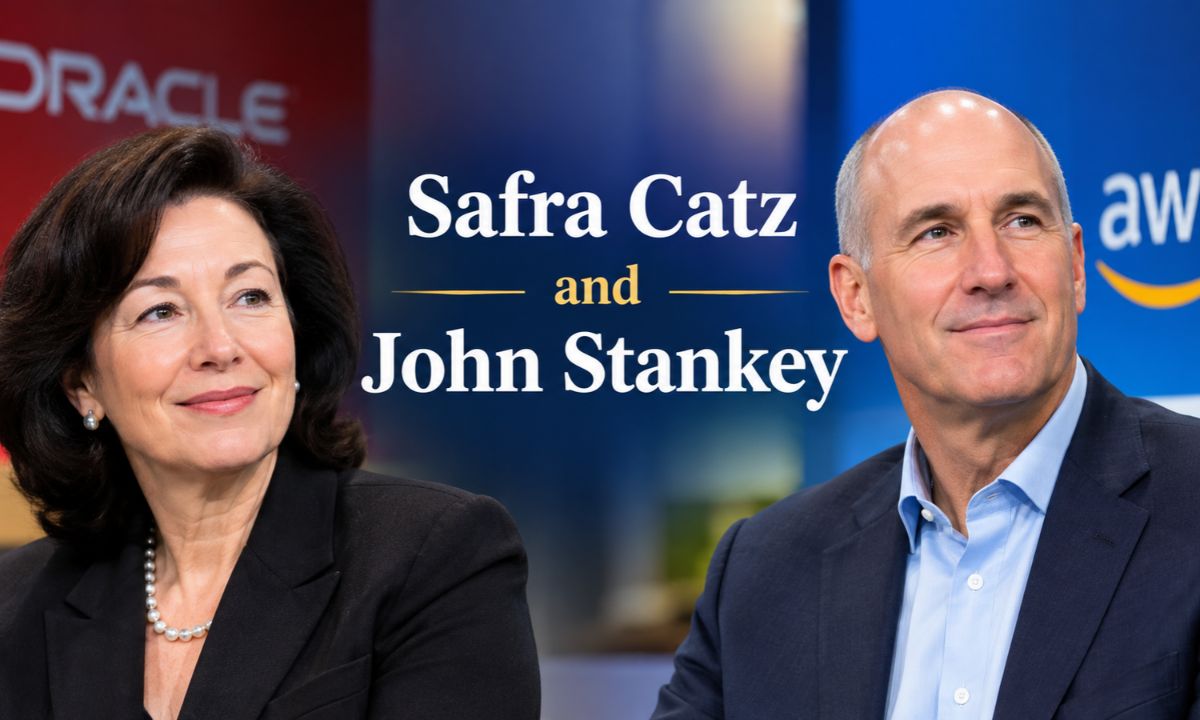

Safra Catz and John Stankey have spent decades steering giant American companies through change. One built Oracle through bold acquisitions. The other rebuilt AT&T around its network. You might expect similar playbooks. Instead, their paths could hardly differ. This guide shows how each leader shaped business leadership in the tech and telecom worlds.
Oracle and AT&T touch your daily life more than you think. One powers cloud computing and artificial intelligence for large enterprises worldwide. The other connects your phone and home through fiber and wireless. Below, you’ll see how Safra Catz and John Stankey compare, what each leader changed, and where both stand in 2026 and beyond.
Who Is Safra Catz?
Safra Catz ranks among the most influential Oracle leaders of the past generation. She rarely gives speeches. Yet she moved markets and shaped a cloud giant. Her story starts with finance and deal-making, not software.
Catz was born in Holon, Israel. She holds US citizenship. She later built a career spanning banking, enterprise software, and public boards. Few executives combine such range. For US readers, her profile offers a clear lesson in disciplined business leadership.
Early Life and Education of Oracle’s Safra Catz
Catz was born in December 1961 in Holon, Israel. She studied at the University of Pennsylvania, one of America’s top schools. That education set her up for finance. It also opened doors to investment banking long before she joined Oracle.
From Investment Banking to Tech Finance
Catz began in investment banking. At Donaldson, Lufkin & Jenrette she became a managing director serving technology clients. That work taught her exactly how tech companies earn and spend their money. It shaped her numbers-first style years later at Oracle.
Key takeaway: Catz learned technology finance before she ever ran a tech company.
Read More: Adin Ross Net Worth: Kick Deal, Income, and Luxury Lifestyle
How Safra Catz Built Her Career at Oracle
Catz joined Oracle in April 1999. She reached the Oracle board in 2001. From there, she became the company’s deal engine. Her disciplined work turned a database firm into a major global cloud computing player.
Her tenure included more than 130 deals by one count. It also included the leap from co-CEO to sole CEO. Each step reflected the same habit: buy smartly, integrate quickly, and keep the numbers tight.
Joining Oracle and the PeopleSoft Deal
Catz is credited with driving the $10.3 billion PeopleSoft acquisition in 2005. That landmark deal set the pattern for years of acquisitions at Oracle. It showed investors that she could close big transactions and absorb rivals without ever losing focus.
Case Study: The PeopleSoft Takeover
- Deal value: $10.3 billion
- Year: 2005
- Result: A template for more than 130 later deals
Catz’s Acquisition Strategy Explained
Think of Catz as a puzzle collector. Each acquisition added a piece to Oracle’s enterprise technology picture. One account counts more than 130 deals under her watch. The goal stayed simple: buy growth, fold it in, and keep the machine growing.
From Co-CEO to Sole CEO
In 2014 Catz became co-CEO alongside Mark Hurd. She became sole Oracle CEO in 2019 after Hurd resigned for health reasons. Her rise was gradual rather than sudden. By the time she took full control, she already knew every lever.
Leading Oracle Into Cloud and AI
Under Catz, Oracle pushed hard into cloud infrastructure. Founder Larry Ellison credited her with leading the company to hyperscale cloud status. Today, Oracle Corporation competes in cloud and artificial intelligence, where huge enterprise computing demand shapes every major strategic decision.
The 2025 Move to Executive Vice Chair
In September 2025, Oracle announced that Catz would become executive vice chair after 11 years as CEO. Clay Magouyrk and Mike Sicilia took over as co-CEOs. The news arrived during a major closely watched handoff as Oracle’s shares jumped 36%.
Safra Catz Career Timeline
- 1999: Joins Oracle
- 2001: Joins the Oracle board
- 2005: Drives the PeopleSoft takeover
- 2014: Becomes co-CEO
- 2019: Becomes sole CEO
- 2025: Moves to executive vice chair
Who Is John Stankey?
John Stankey is the AT&T CEO who refocused a telecom giant on its network. He prefers hands-on operations over deal-making. His career stayed inside one company family. That long-term focus defines how he leads today.
Unlike Catz, he never worked in banking or switched industries. He grew up in Los Angeles and started at AT&T’s predecessors in the 1980s. For you as a reader, his story shows the power of deep operational knowledge.
Early Life and Education of AT&T CEO John Stankey
Stankey grew up in Los Angeles. He earned his undergraduate degree at Loyola Marymount University. He later completed an MBA at UCLA, which sharpened his business skills. Those choices kept him rooted in California before a long, steady telecom career took hold nationwide.
A One-Company Career
Stankey’s path runs almost entirely through AT&T and its predecessors. SBC merged with AT&T in 2005 yet his core work stayed in telecom. Compare that to Catz, who arrived at Oracle from outside. One leader is a lifer. The other was an outsider.
John Stankey’s Climb Through AT&T
Stankey climbed through nearly every major function at AT&T. He worked in technology, strategy, and media before reaching the top. Each role added a layer of operating knowledge. Together, they prepared him to run a vast network business.
His rise followed a clear order. First came information technology. Next came engineering, then strategy, then media. Finally, he became CEO in 2020 and chairman in 2025. This steady climb gave him credibility inside the company.
From CIO to CTO to Chief Strategy Officer
After SBC merged with AT&T in 2005, Stankey became chief information officer of the combined company. He served as chief technology officer from 2008 to 2012. Afterward, he became chief strategy officer, which gave him a wide view of the business.
Running WarnerMedia
Later, Stankey ran the media arm and led WarnerMedia. He then served as president and chief operating officer. That stretch placed him inside the media industry at a pivotal time. It also set up the major sale decisions that followed.
Becoming CEO and Chairman
Stankey succeeded Randall Stephenson as AT&T CEO in July 2020. In February 2025, the board elected him chairman. Since then, he has held both top seats. That combination gives him unusual authority to steer corporate strategy and capital decisions alike.
Selling Off the Media Empire
His tenure centers on unwinding the media empire. AT&T sold part of DirecTV to TPG in 2021. In September 2024, it announced the sale of its remaining 70% stake for $7.6 billion. Together, those moves refocused the company on connectivity.
Case Study: The DirecTV Exit
- 2021: Partial sale to TPG
- 2024: Remaining 70% stake sold for $7.6 billion
- Result: A sharper focus on connectivity
- Shift at a glance: Media empire → Divestitures → Fiber and wireless
What Stankey Changed Inside AT&T
Selling assets was the easy part. Changing habits took longer. In a 2026 Harvard Business Review interview, Stankey described a strategy reset that reached culture, products, and daily work. The shift touched how teams operate.
His reset had three pillars: a customer-led mindset, AI in products and performance, and more in-person collaboration. Each pillar targets the same goal. AT&T wants to run its network business with sharper focus and clearer priorities.
A Customer-Led Mindset
Stankey told Harvard Business Review he pushed teams toward a more customer-led mindset. In plain terms, employees start with what customers need. Then they work backward to products and networks. This simple approach turns a strategy reset into daily habits.
AI Inside Products and Performance
Stankey brought AI into AT&T products and performance. He is also very blunt about AI disruption. He told TIME that any executive who thinks AI won’t disrupt their business is naive. For AT&T, AI strategy is simply not optional anymore.
The Push for In-Person Collaboration
Stankey also encouraged in-person collaboration. That stands out in an era of remote work. The logic is simple. Teams solve hard problems faster when they share a room. Whether you agree or not, it signals a culture built on direct connection.
Fiber, Wireless, and the Network Bet
Underneath every change sits one big bet. AT&T wants to win through fiber and wireless connectivity. The company rebuilt itself around its network rather than content. For you as a customer, that means investment flows into faster home internet and mobile service.
Safra Catz and John Stankey: A Side-by-Side Look
Safra Catz and John Stankey faced the same era and the same pressure. Yet they chose different playbooks. One bought growth. The other narrowed the business to its core. Both approaches reflect real choices in corporate strategy.
Think of it like two chefs in two kitchens. One adds ingredients until the dish works. The other removes everything that doesn’t belong. Both can win. The table and sections below show where their paths meet and split.
Where Catz and Stankey Overlap
Their paths cross in the media industry. Stankey ran WarnerMedia while Catz served on Disney’s board from 2018 to 2024. Both have led organizations where AI has become the central strategic question today, which makes their experience worth comparing.
How Their Paths Differ
Catz joined Oracle in her late thirties from outside. She grew the company by acquiring others. Stankey joined AT&T in the 1980s and grew by running operations. She became known for buying growth. He became known for narrowing the business.
Comparison Table: Oracle and AT&T Leaders
This table puts the Oracle and AT&T leaders side by side. It highlights their background, timing, top roles, and signature moves. Use it as a quick reference when comparing technology leadership and telecom leadership across their long careers. Skim it first, then read the details above.
| Category | Safra Catz | John Stankey |
| Company | Oracle | AT&T |
| Background | Investment banking | Telecom operations |
| Joined | 1999 | 1980s |
| Top role | CEO until 2025, now executive vice chair | CEO since 2020 and chairman |
| Signature move | PeopleSoft and serial acquisitions | Media divestitures |
| Core bet | Cloud and AI | Fiber and wireless |
Why Neither Approach Wins Outright
Neither approach is universally better. Each fit the problem its company faced. Oracle needed growth in cloud infrastructure. AT&T needed focus on its network. The lesson for you is refreshingly simple: strategy works when it matches the company’s real weakness.
Key takeaway: Buying growth and narrowing focus can both work when they fit the problem.
Where Each Leader Stands in 2026
In 2026, one leader stepped back while the other leaned in. Catz now guides Oracle from the board. Stankey still runs AT&T day to day. Their current roles show two very different stages of corporate leadership.
These updates matter to US readers because both companies sit at the center of the American economy. Oracle supplies enterprise technology. AT&T supplies connectivity. Together, they show how technology and telecom leaders respond when AI reshapes entire industries.
Safra Catz in 2026
Catz remains on Oracle’s board. She lectures at Stanford Graduate School of Business, chairs the Oracle Education Foundation, and serves as a trustee of In-Q-Tel. Some sources also list her on the Paramount Skydance board. Her role now centers on guidance.
John Stankey in 2026
Stankey remains firmly in charge. AT&T marked 150 years since Bell’s first phone call in March 2026. It pledged to invest over $250 billion in its networks. He also updated investors at a Goldman Sachs Communacopia + Technology Conference on September 9.
AT&T 2026 Snapshot
- Network pledge: More than $250 billion
- Second quarter growth: Over one million Advanced Connectivity subscribers
- Investor update: September 9 conference appearance
What These Moves Signal for US Business
Both leaders show that strategy follows company needs. Oracle’s leadership handoff suggests confidence in a new generation guiding cloud and AI. AT&T’s network pledge suggests long-term faith in connectivity. For US business, the message is simple and clear: focus beats drift.
Frequently Asked Questions
Who Is Safra Catz?
Safra Catz is a veteran executive and former Oracle CEO. She started in investment banking, joined Oracle in 1999, and led the company as sole CEO from 2019 to 2025. She now serves as executive vice chair and sits on the Oracle board.
Is Safra Catz Still the CEO of Oracle?
No. Safra Catz moved out of the CEO role in September 2025 after 11 years in the job. She became executive vice chair and remains on the Oracle board. Clay Magouyrk and Mike Sicilia now lead the company together as co-CEOs.
Who Is John Stankey?
John Stankey is the CEO and chairman of AT&T. He grew up in Los Angeles, studied at Loyola Marymount University and UCLA, and spent nearly his whole career at AT&T and its predecessors. He took the top job in July 2020.
How Long Has John Stankey Been AT&T’s CEO?
Stankey became AT&T CEO in July 2020, succeeding former CEO Randall Stephenson. As of October 2026, that is more than six years in the role. The board also elected him chairman in February 2025. He now holds both top titles.
What Do Safra Catz and John Stankey Have in Common?
Both have ties to the media industry. Stankey ran WarnerMedia while Catz served on Disney’s board from 2018 to 2024. Both also led companies where AI became the central strategic question and both spent decades guiding large organizations through technology upheaval.
How Do Catz and Stankey Differ as Leaders?
Catz grew Oracle through acquisitions and bet on cloud infrastructure. Stankey narrowed AT&T to its core and bet on fiber and wireless. She joined from outside while he rose inside one company family. Their styles suited the different problems each company faced.
Who Replaced Safra Catz as Oracle CEO?
Clay Magouyrk and Mike Sicilia replaced Safra Catz as Oracle co-CEOs. Oracle announced the change in September 2025. Catz became executive vice chair after 11 years as CEO. Oracle’s shares jumped 36% as the news arrived. The two executives now share the top job.
Final Thoughts
Safra Catz and John Stankey show two ways to lead through disruption. She expanded outward and bet on cloud infrastructure. He narrowed the business and bet on the network. Both leaders left a lasting mark on corporate strategy.
The takeaway is simple. Strategy works when it fits the company’s weakness. No formula works everywhere. So which style would you back in your own business: the bold acquirer or the focused operator? Share your thoughts in the comments and subscribe for more leadership profiles.

Jaxon is the voice behind Namez Home, bringing creative name ideas, meanings, and naming inspiration to audiences worldwide.